
Bank of England Base Rate History

Bank of England Base Rate History
Keep up to date with the history of the Bank of England Bank Rate and how it has changed over time.
We regularly update this page using information from the Bank of England to provide a straightforward record of past Bank Rate decisions, including when rates were increased, reduced or held.
You can also see how changes in Bank Rate may have influenced UK mortgage rates and borrowing costs.
Current Bank of England Base Rate
The current Bank of England Bank Rate is 3.75%
At its most recent meeting on 17th September 2026 , the Monetary Policy Committee (MPC) voted by a majority of 6–3 to hold Bank Rate at 3.75%
The next scheduled Bank Rate decision is due on 5th November 2026.
The Bank of England’s Monetary Policy Committee (MPC) reviews Bank Rate regularly as part of its role in maintaining price stability in the UK.
For our latest commentary on Bank Rate, mortgage rates, inflation and the wider housing market, visit our Mortgage & Housing Market Update.
What Is the Bank of England Bank Rate?
Bank Rate is the interest rate set by the Bank of England’s Monetary Policy Committee (MPC).
It influences the cost of borrowing across the UK economy and can affect the interest rates available on mortgages, loans and savings accounts.
The MPC considers factors including inflation, economic growth, employment and wider economic conditions when deciding whether Bank Rate should be increased, reduced or left unchanged.
Bank of England Base Rate History
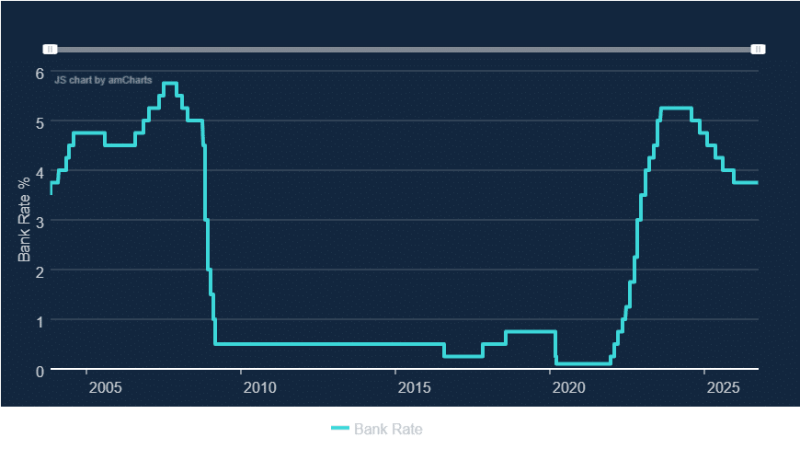
The chart below shows how Bank Rate has changed over time.
Bank Rate Changes in 2026
| MPC meeting | Bank Rate | Change |
|---|---|---|
| September 2026 | 3.75% | Held |
| July 2026 | 3.75% | Held |
| June 2026 | 3.75% | Held |
| April 2026 | 3.75% | Held |
| March 2026 | 3.75% | Held |
| February 2026 | 3.75% | Held |
Bank Rate Changes in 2025
| MPC meeting | Bank Rate | Change |
|---|---|---|
| December 2025 | 3.75% | −0.25% |
| November 2025 | 4.00% | Held |
| September 2025 | 4.00% | Held |
| August 2025 | 4.00% | −0.25% |
| June 2025 | 4.25% | Held |
| May 2025 | 4.25% | −0.25% |
| March 2025 | 4.50% | Held |
| February 2025 | 4.50% | −0.25% |
Find out Your Options
How Has Bank Rate Changed Over Time?
Bank Rate has moved through very different periods as the Bank of England has responded to changes in inflation and the wider UK economy.
Following the 2008 financial crisis, interest rates were reduced sharply to support the economy. Bank Rate fell from 5% in October 2008 to 0.5% by March 2009 and then remained at historically low levels for several years.
During the Covid-19 pandemic, the Bank of England reduced Bank Rate further. It fell from 0.75% to 0.25% on 11 March 2020 and then to 0.10% on 19 March 2020, its lowest recorded level. The reduction formed part of the Bank’s response to the significant disruption caused by the pandemic.
Bank Rate began rising again in December 2021 as inflation increased. A series of increases took Bank Rate from 0.10% to 5.25% by August 2023, where it remained until August 2024.
The Bank of England then began reducing Bank Rate as inflationary pressures eased. The first reduction came in August 2024, when Bank Rate fell from 5.25% to 5.00%. Further reductions followed, taking Bank Rate to 3.75% by December 2025. It has remained at 3.75% throughout the MPC decisions held so far in 2026.
The history of Bank Rate shows why mortgage rates can look very different from one period to another. However, Bank Rate is only one factor affecting mortgage pricing, particularly for fixed-rate mortgages.
What Is the Highest Bank of England Base Rate?
The highest rate recorded in the Bank of England’s historical Bank Rate data is 17%, which was reached on 15 November 1979.
At the time, the official policy rate was known as the Minimum Lending Rate. The 17% rate was introduced during a period of very high inflation and significantly higher borrowing costs than borrowers have become accustomed to in more recent decades.
What Is the Lowest Bank of England Base Rate?
The lowest Bank Rate on record is 0.10%.
The Bank of England reduced Bank Rate to 0.25% on 11 March 2020 and then to 0.10% on 19 March 2020 as part of its response to the economic disruption caused by Covid-19. Bank of England
Bank Rate remained at 0.10% until December 2021, when the Monetary Policy Committee increased it to 0.25%.
How Often Does the Bank of England Change Bank Rate?
The Bank of England’s Monetary Policy Committee (MPC) normally meets eight times a year to decide the appropriate level of Bank Rate.
A meeting does not automatically result in an interest-rate change. At each meeting, the MPC can decide to increase, reduce or hold Bank Rate depending on its assessment of inflation and economic conditions.
Why Does the Bank of England Change Bank Rate?
The Bank of England uses Bank Rate as one of its main tools for influencing inflation and economic activity.
Its Monetary Policy Committee is tasked with maintaining price stability and aims to keep inflation at the Government’s 2% target over time.
Increasing Bank Rate generally makes borrowing more expensive and can encourage saving. This can reduce spending and demand within the economy, which may help bring inflation down.
Reducing Bank Rate generally makes borrowing cheaper and can discourage saving. This can support consumer spending, business investment and economic activity when the economy is weaker.
The MPC therefore considers a wide range of information before making a decision, including inflation, wages, employment, consumer spending and economic growth.
Bank Rate is not changed according to a fixed formula. The MPC assesses the economic outlook at each meeting and decides what level of interest rates it believes is necessary to keep inflation on track towards its target.
How Does Bank Rate Affect Mortgage Rates?
Bank Rate can have an important influence on mortgage pricing, but Bank Rate and mortgage rates are not the same thing.
The effect on an individual borrower depends partly on the type of mortgage they have.
Tracker Mortgages
Tracker mortgages usually have an interest rate linked directly to Bank Rate.
For example, a tracker may be priced at Bank Rate plus a fixed percentage margin. If Bank Rate increases or decreases, the mortgage rate will normally move by the same amount, subject to the terms of the mortgage.
This means changes in Bank Rate can affect monthly payments relatively quickly for borrowers on tracker mortgages.
Variable-Rate Mortgages
Bank Rate can also influence standard variable rates and other lender-managed variable mortgage rates.
However, these rates are set by the individual lender and do not necessarily move by exactly the same amount or at exactly the same time as Bank Rate.
Borrowers should therefore check the terms of their particular mortgage rather than assuming their rate will automatically follow every MPC decision.
Fixed-Rate Mortgages
Fixed mortgage rates do not directly follow Bank Rate.
When lenders price fixed-rate mortgages, they consider a wider range of factors, including expectations for future interest rates, swap rates, funding costs, competition between lenders and the type of mortgage being offered.
This is why fixed mortgage rates can sometimes fall before the Bank of England cuts Bank Rate, or increase even when Bank Rate has not changed.
How Do Swap Rates Affect Mortgage Rates?
Swap rates are an important part of how lenders price many fixed-rate mortgages.
In simple terms, swap rates reflect financial-market expectations for interest rates over a future period. Mortgage lenders can use these markets to help manage the risk of offering fixed borrowing rates to customers.
This means fixed mortgage rates can move even when the Bank of England Bank Rate has not changed.
For example, if markets expect Bank Rate to fall in the future, swap rates may reduce before the Monetary Policy Committee actually cuts Bank Rate. Lenders may then be able to reduce some fixed mortgage rates in advance of an official Bank Rate change.
The opposite can also happen. If markets begin to expect higher inflation or higher future interest rates, swap rates can increase, which may put upward pressure on fixed mortgage pricing even if Bank Rate is currently unchanged.
Bank Rate vs Swap Rates vs Mortgage Rates
| Bank Rate | Swap Rates | Mortgage Rates | |
|---|---|---|---|
| What are they? | The official policy interest rate set by the Bank of England | Market rates that reflect expectations for future interest rates over different periods | The interest rates charged by mortgage lenders on individual mortgage products |
| Who sets them? | Bank of England Monetary Policy Committee | Determined by financial markets | Individual mortgage lenders |
| How often can they change? | Following MPC decisions | They can move daily | Whenever lenders change or launch mortgage products |
| What influences them? | Inflation, economic growth, employment and wider economic conditions | Expectations for future Bank Rate, inflation and economic conditions | Bank Rate, swap rates, lender funding costs, competition, risk appetite and borrower circumstances |
| Do they directly affect tracker mortgages? | Usually, depending on the product terms | Normally not directly | The tracker rate will depend on the lender’s product terms |
| Do they affect fixed mortgage rates? | Indirectly | Often an important influence | Fixed rates are set by the lender for an agreed period |
| Can they move before an MPC decision? | No | Yes | Yes |
Does a Bank Rate Cut Mean Mortgage Rates Will Fall?
Not necessarily. A reduction in Bank Rate can influence mortgage pricing, but it does not mean that every mortgage rate will immediately fall.
Tracker mortgages linked directly to Bank Rate will normally respond according to the terms of the product.
Fixed-rate mortgages are different. Their pricing is influenced heavily by expectations for future interest rates and swap rates. If financial markets have already anticipated a Bank Rate reduction, lenders may have reflected that expectation in their mortgage pricing before the MPC announces its decision.
Mortgage rates can also be affected by lender funding costs, competition, loan-to-value and individual lender appetite.
This means borrowers should look at the mortgage market as a whole rather than relying solely on the current Bank Rate when deciding whether to secure a new deal.
Bank Rate vs Inflation
Bank Rate and inflation are two different measures.
Bank Rate is an interest rate set by the Bank of England’s Monetary Policy Committee. It is used as part of monetary policy to influence borrowing, saving, spending and inflation.
Inflation measures how quickly the overall price of goods and services is changing. The main measure used by the Bank of England when setting monetary policy is the Consumer Prices Index (CPI).
If inflation remains above the Bank of England’s target, higher interest rates can help reduce demand and inflationary pressure. If inflation is lower and economic conditions are weak, there may be greater scope for interest rates to be reduced.
For a record of how UK inflation has changed over time, see our Inflation History page.
What Could Happen to Bank Rate Next?
Future Bank Rate decisions will depend on how inflation and the wider UK economy develop.
Expectations can change quickly as new inflation, employment, wage-growth and economic-growth figures are published. Changes in financial markets and international economic conditions can also affect the outlook.
For that reason, we keep detailed forecasts and our mortgage-rate outlook on our regularly updated Mortgage & Housing Market Update page.
Looking for Mortgage Advice?
Changes in Bank Rate can affect borrowers differently depending on the type of mortgage they have, when their current deal ends and their individual circumstances.
If your mortgage deal is coming to an end, or you would like to understand the mortgage options currently available, Kerr & Watson can compare suitable products from across the market and provide advice based on your circumstances.
Why Kerr & Watson?

Understanding
We take the time to understand your situation so that we can search for the most suitable mortgage and insurance for you. Any recommendation made is completely bespoke to your circumstances.

Experience
Mortgage and insurance advice is our speciality. We have decades of combined experience giving us the knowledge to overcome challenges and find the appropriate solution for your needs.

Communication
We work around your schedule to arrange a mortgage or insurance policy that suits your needs. You’ll be kept updated throughout the entire process with clear communication so you’ll always know what’s going on.
Featured In






Testimonials


Awards & Recognition







Contact Us
Free initial conversation. No obligation.
Not ready to apply yet? That’s fine — we can start with a quick conversation about your options.
We aim to respond within a few hours during working days.
By submitting this form you agree that Kerr & Watson may contact you regarding your enquiry.
Your information will be handled in accordance with our Privacy Policy.